


 15:58

Degrees vs Radians vs Gradians: Which is better and why?
Think degrees are a fundamental law of physics? Think again. The 360° circle isn’t woven into the fabric …
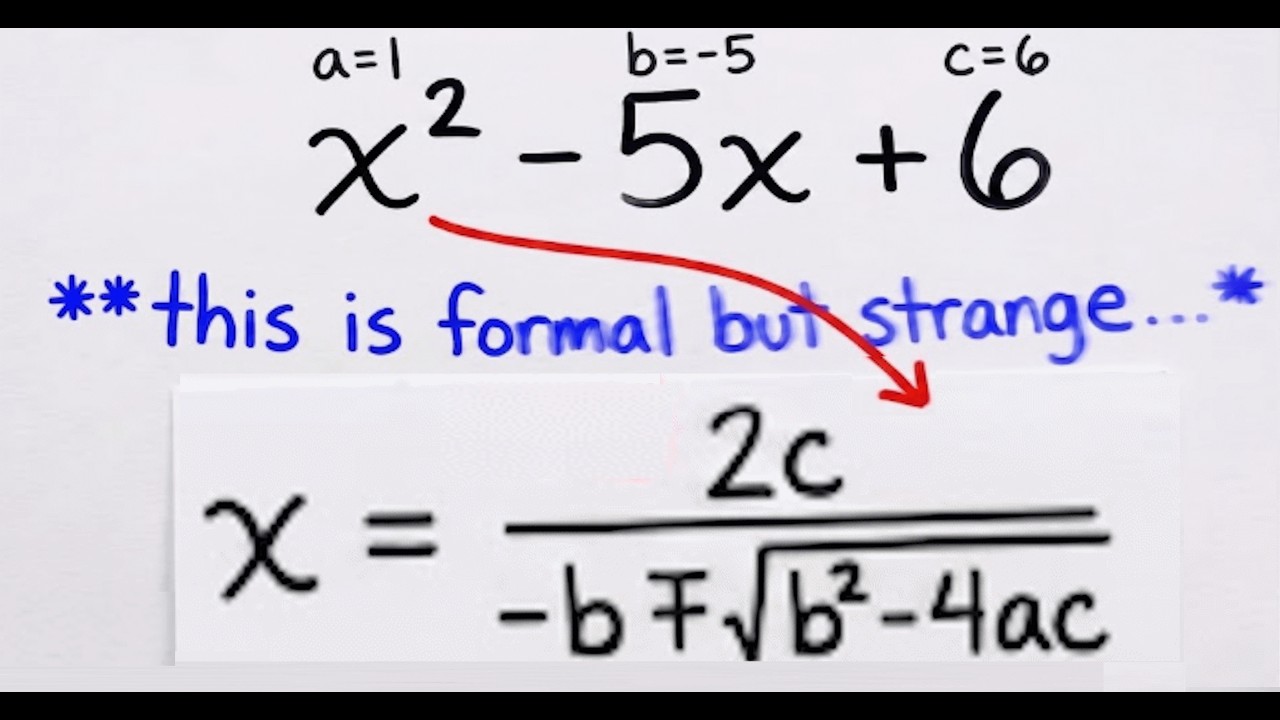
In high school math, the quadratic formula is drilled into our brains like a sacred nursery rhyme: $x = \frac{-b \pm \sqrt{b^2 - 4ac}}{2a}$. We memorized it, plugged in numbers, and accepted it as the only absolute truth for solving second-degree polynomials. But what if there’s an alternative formula hiding in plain sight—one that completely flips the fraction on its head, sends $2c$ to the numerator, and shoves the radical down into the denominator?
At first glance, it looks like a typo or an impossible optical illusion. Yet, not only is this “inverse quadratic formula” mathematically airtight via algebraic conjugates, it quietly rescues modern software from catastrophic breakdown. When numbers grow massive, computers running standard algebra crash into floating-point rounding errors and precision collapse. Discover how programmers combine both formulas into an ingenious algorithmic duet—extracting flawless roots without ever running a dangerous calculation.
15:58Think degrees are a fundamental law of physics? Think again. The 360° circle isn’t woven into the fabric …
 04:05
What happens when you multiply an infinite, non-repeating decimal by itself? With numbers like the square root …
