




 3 Videos
19:11

Pythagorean Triples Trilogy: Mental Math, The Unit Circle & Euler's Totient
The Story: The 2,500-Year Quest for Integer Right Triangles The Pythagorean Theorem, $a^2 + b^2 = c^2$, is …
In grade school, we were all taught rapid divisibility tricks like cookbook recipes:
To most people, these feel like disconnected, arbitrary parlor tricks. But beneath the surface lies one of the most elegant and unified concepts in mathematics: modular arithmetic applied to the base-10 positional number system.
In this 4-part masterclass, we pull back the curtain on this engine—starting from fundamental parity ($\mathbb{Z}_2$), advancing through decimal polynomial expansion and alternating signs modulo 11, and concluding with a cutting-edge universal algorithm for any divisor ending in 1 ($10k + 1$).
We’ve all memorized the neat little math tricks since grade school: check the last digit for 2, 5, and 10, glance at the last two digits for 4, and magically add up all the digits to test for 3 and 9. But have you ever stopped to wonder why these shortcuts actually hold true, or why an innocent sum of digits can tell you anything about a number stretching across millions? When it comes to the “rule breakers” of arithmetic—notorious prime divisors like 7 and 11—standard intuition breaks down completely, forcing most people right back into the chore of tedious long division.
Beneath every shortcut lies the elegant anatomy of our base-10 number system and a universal principle of divisibility of sums that lets you strip away mathematical noise. By cracking open how powers of 10 break down into strings of 9s and engineering algebraic “shrink rays” using co-prime scaling, this deep dive proves every single rule from the ground up. Discover how to dismantle massive numbers effortlessly, uncover the secret mechanics behind the mysterious rules for 7 and 11, and never look at mental math the same way again.
Most people know the standard shortcuts for testing divisibility by 2, 5, or 10, but when it comes to testing for 11, arithmetic seems to play by its own rules. While the traditional method involves an awkward chopping trick—lopping off digits and subtracting across remaining chunks—there is a vastly superior, rhythmic shortcut: simply alternating between addition and subtraction across the digits. But does it matter if you start from the left or the right, and why does this alternating dance magically sniff out multiples of 11 every single time?
Beneath this parlor trick lies a breathtaking geometric ping-pong match hidden inside our base-10 number system. Every power of 10 sits exactly one step above or one step below a clean multiple of 11. By expanding powers through the Binomial Theorem and deploying mathematical induction to knock down infinite algebraic dominoes, we prove why the isolated digits naturally form an alternating sum—and why flipping your signs still hits the exact same truth.
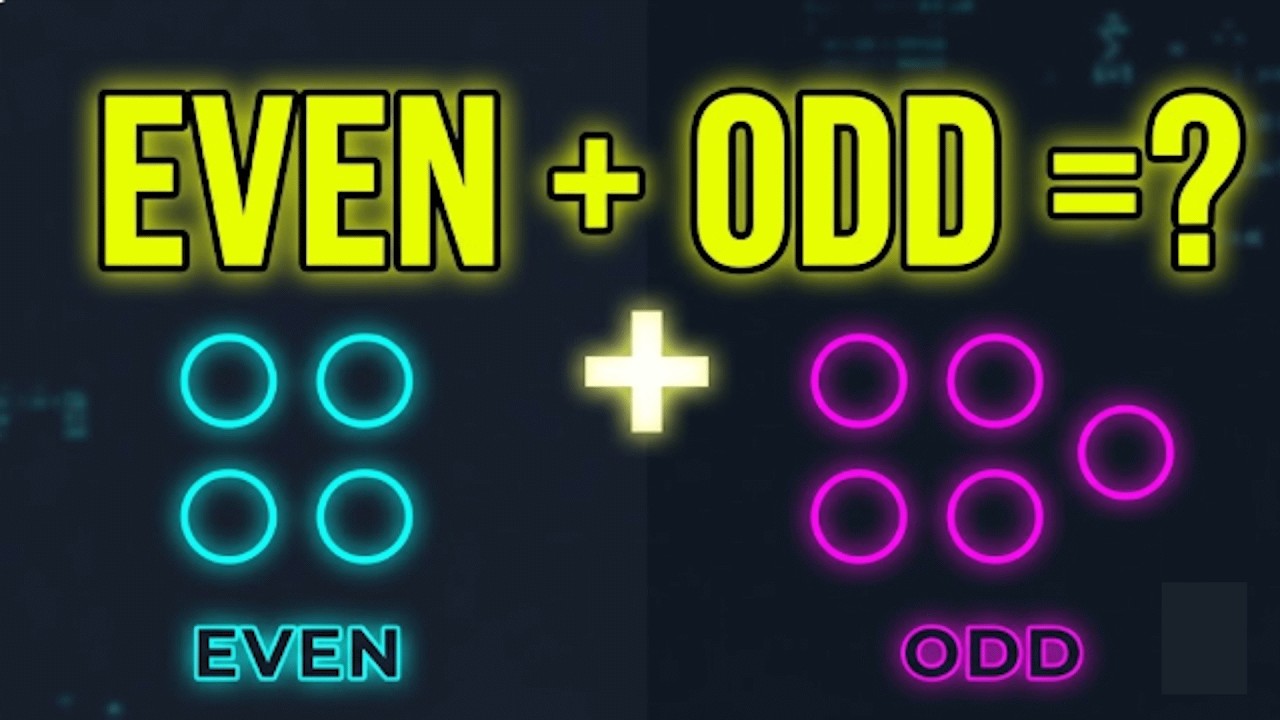
Every single integer in existence belongs to one of two strict, non-negotiable clubs: even or odd. While we’re taught the basic rules of parity in grade school, most people view them as little more than cute arithmetic shortcuts. But beneath the surface, parity is the backbone of modern computer science, error-detecting codes, and cryptography. The real magic isn’t just knowing that an odd number plus an odd number makes an even number—it’s understanding the airtight algebraic machinery that makes it mathematically impossible to be anything else.
What happens when you test parity across every major operation—from negative counter numbers to exponential towers? In this deep dive, we strip away the guesswork and put every rule on trial. Using algebraic definitions, direct proofs, and proof by contradiction, discover why a single even factor “infects” an entire product, why exponents completely preserve parity, and how a few simple rules let you solve complex integer puzzles instantly without touching a calculator.
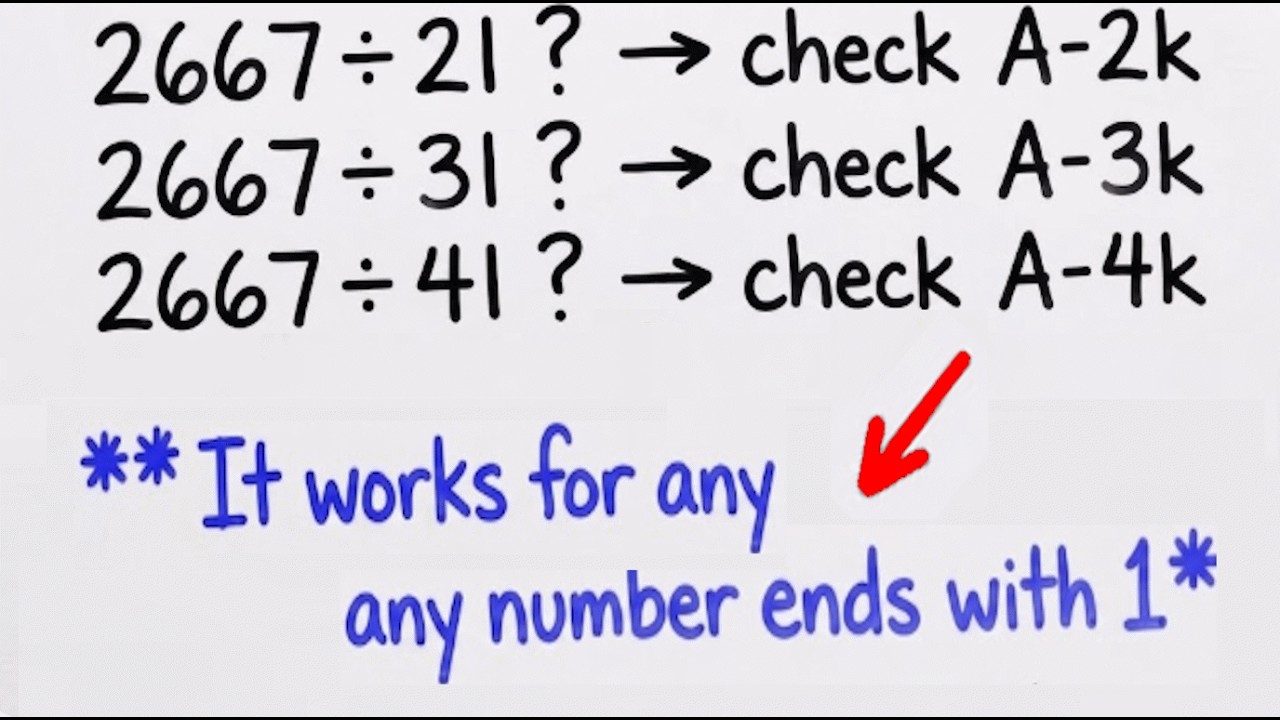
At first glance, testing whether a massive integer divides evenly by numbers like 41, 51, or 71 seems like a punishment reserved for tedious long division. While everyone knows the classic schoolyard tricks for small digits, large prime and composite numbers ending in 1 appear to have no recognizable patterns at all. Faced with a giant number, most people assume mental arithmetic hits an impenetrable brick wall—forcing you back to scratch paper and mindless calculation.
Beneath the surface, however, these numbers all belong to a single, elegant mathematical family: $10k + 1$. By leveraging Euclid’s Lemma and isolating the final digit, you can build an algebraic “whittling algorithm” that systematically strips away place values and collapses huge numbers down in seconds. Once you see the formal induction proof that guarantees this shortcut never fails, you’ll possess a master key to test divisibility for an entire infinite series of divisors without ever touching long division again.
3 Videos
19:11The Story: The 2,500-Year Quest for Integer Right Triangles The Pythagorean Theorem, $a^2 + b^2 = c^2$, is …
 05:49
Every number in existence belongs to one of two opposing camps: the dependable, well-behaved rational numbers …
